
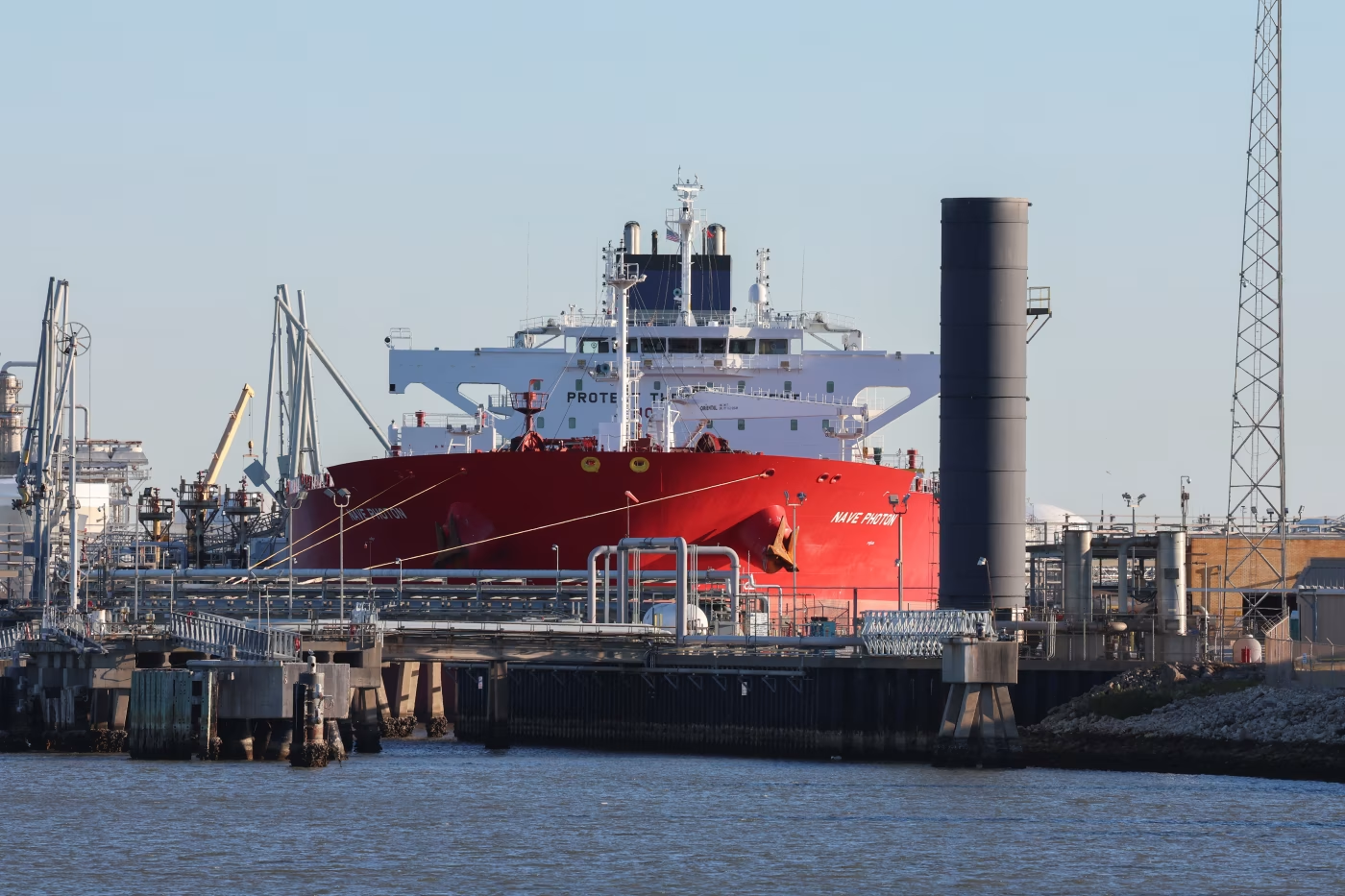
tanker with Venezuelan crude oil at Freeport, Texas, last week. Antranik Tavitian/Reuters
Chevron’s Venezuela Dilemma: Balancing Strategy, Politics and Profit
Chevron teeters between supporting President Trump’s Venezuela vision and protecting shareholder returns as geopolitical risk, legal uncertainty and economics collide.
Chevron must wrestle with a strategic conundrum: back Donald Trump’s ambition to reintegrate Venezuelan oil into global markets, while avoiding huge capital commitments that could undermine earnings and shareholder value. The situation highlights the complex interplay of geopolitics, energy policy and corporate risk management facing U.S. oil majors in 2026.
Trump’s Venezuela Push & Chevron’s Position
Following the dramatic ouster of Nicolás Maduro, the Trump administration has been encouraging U.S. oil companies to invest $100 billion to revive Venezuela’s long-neglected oil sector—once among the richest in crude reserves globally. Chevron is the only major U.S. company currently active in Venezuela and is best positioned to scale production quickly using existing infrastructure.
President Trump envisions Venezuela contributing to U.S. energy security and lower oil prices, but Chevron’s executives are wary. Venezuelan heavy crude historically fetches $30–$40 per barrel—below typical profitability thresholds for major integrated oil companies—and the current price dynamics conflict with Trump’s target of $50 per barrel. This fundamental economics problem makes large scale investment unappealing without reforms that improve legal and commercial certainty.
Chevron already produces roughly 240,000 barrels a day in Venezuela and could potentially double output if conditions permit. Yet the company is hesitant to commit additional capital without guarantees on legal framework, property rights and sanctions relief—areas where clarity is still lacking.
Broader Industry Skepticism
Chevron’s caution is echoed across the industry. ExxonMobil, for example, has labeled Venezuela “currently uninvestable,” asserting that significant legal and commercial changes would be required before any meaningful reinvestment. This lukewarm reception illustrates that Trump’s public enthusiasm is not fully shared by oil executives who must balance strategic rhetoric with risk-adjusted returns.
Part of this skepticism stems from Venezuela’s historical trajectory. Decades of political turmoil, declining output, capital flight and structural weaknesses in the energy sector have eroded investor confidence. Caracas’s oil infrastructure—which once underpinned billions of dollars in production—has deteriorated, and foreign operators recall past losses as deterrents to rapid re-entry.
Geopolitical Shifts & Policy Moves
The U.S. government has moved quickly to support Chevron’s operational latitude: Energy Secretary Chris Wright confirmed efforts to expand Chevron’s Venezuela license, enabling it to pay the Venezuelan government in cash rather than in crude, which would increase export flexibility and overall production capacity. Washington has also begun marketing previously stranded barrels under tighter controls, with oil fetching higher market prices as global dynamics shift.
Those moves reflect a broader strategy by the Trump administration to leverage Venezuelan resources for U.S. energy dominance, but they come amid geopolitical uncertainty. Former Venezuelan officials are reportedly engaging more pragmatically with the U.S. post-Maduro, seeking investment and economic cooperation. However, underlying mistrust and unresolved political dynamics continue to cloud the investment outlook.
Economic & Shareholder Calculus
From a corporate finance perspective, Chevron’s dilemma is rooted in risk-reward tradeoffs. Heavy crude extraction is capital-intensive and yields inferior margins compared with lighter grades. Committing tens of billions in capital without clear risk mitigation mechanisms—such as enforceable property rights, protection against expropriation, and stable tax regimes—could dilute investor returns.
Chevron’s leadership, including CEO Mike Wirth, appears committed to supporting national policy goals while insisting on commercial pragmatism. Their public stance underscores an industry imperative: support strategic national objectives when feasible, but avoid large bets that could saddle investors with underperforming assets.
Market & Policy Implications
For energy markets and policymakers, Chevron’s stance offers insight into the limits of geopolitically driven investment ambitions. While Venezuelan oil reserves remain among the world’s largest demonstrable resources, the business case for reinvestment is constrained by economics and politics rather than crude scarcity alone.
U.S. efforts to re-open Venezuela’s oil sector carry broader implications for global energy supply, estimated future production capacity and the strategic positioning of Western energy companies vis-à-vis competitors from China and Russia. Ultimately, the sector’s revival will depend not only on Trump’s vision, but on credible legal frameworks and investor safeguards that align corporate incentives with geopolitical goals.

News
Opinion
WIN Membership
Customer Service
More