
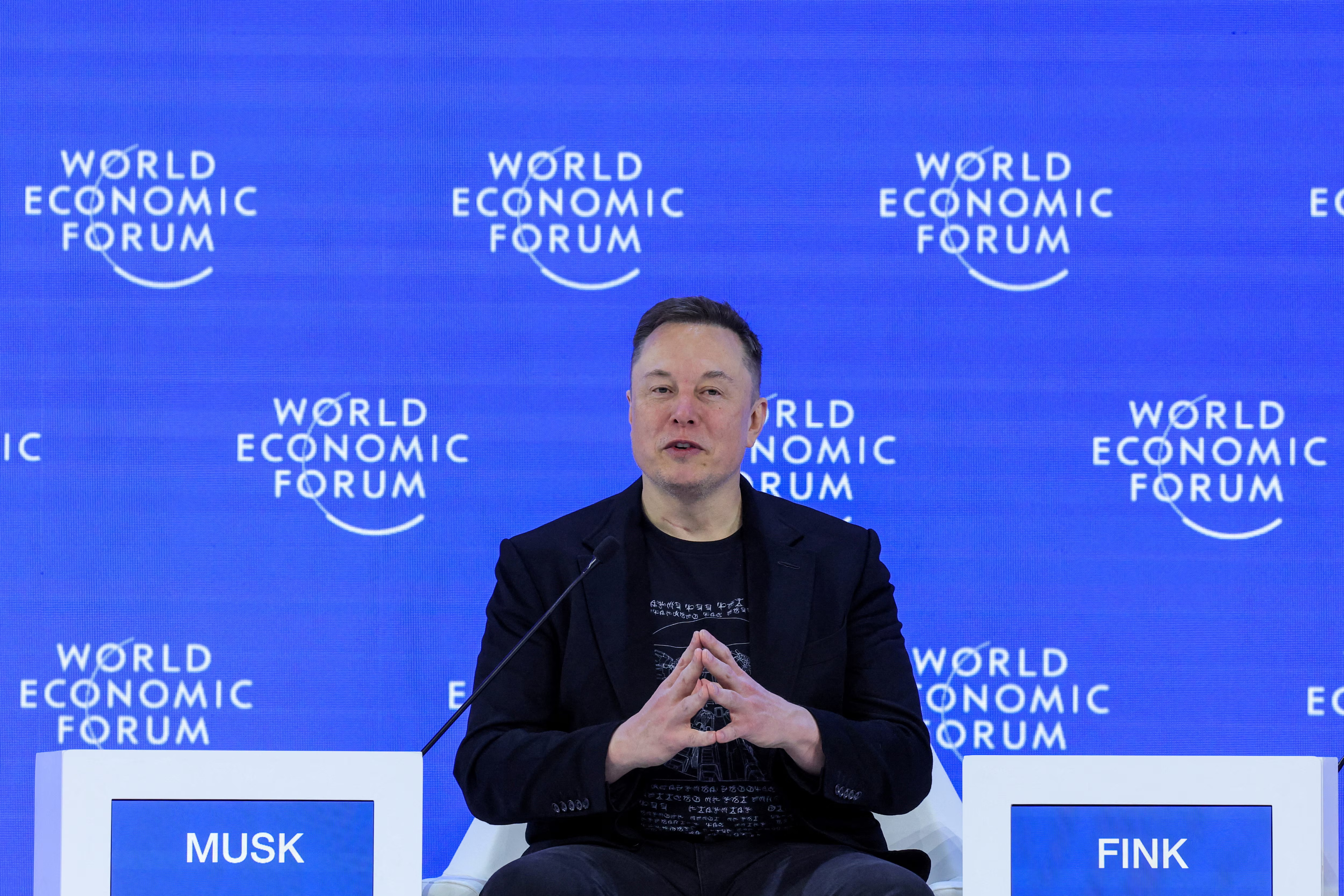
Elon Musk at WEF
Elon Musk
Executive Facts
Born: June 28, 1971, Pretoria, South Africa
Citizenship: South African, Canadian, American
Education:
- Pretoria Boys High School
- Queen’s University (Canada, started studies)
- University of Pennsylvania – BSc Physics & BSc Economics (Wharton)
- Stanford University – PhD program (left after days)
Companies: Tesla, SpaceX, X (formerly Twitter), xAI, Neuralink, The Boring Company
Estimated Net Worth (2026): ~USD 780–800 billion (highly volatile, asset-driven)
The Making of Elon Musk – Origin of a Contrarian
Elon Musk’s story does not begin in Silicon Valley boardrooms or venture capital circles, but in apartheid-era South Africa, where curiosity was often a refuge and books were an escape. As a child, Musk was intensely introspective, fascinated by science fiction, physics, and computing. At the age of twelve, he programmed and sold a simple video game—an early indicator not just of technical aptitude, but of commercial instinct.
His school years were marked by social isolation and bullying. Rather than smoothing his edges, these experiences sharpened them. Musk learned early that systems—machines, code, physics—were more predictable than people. This bias toward systems thinking would later become the backbone of his entrepreneurial philosophy.
At seventeen, Musk left South Africa to avoid mandatory military service and to pursue opportunity elsewhere. Canada became the gateway, followed by the United States. At the University of Pennsylvania, he deliberately chose a dual track: physics to understand how the world works, economics to understand how value is created and distributed. This duality—science plus capital—defines every venture he has since built.
His brief enrollment at Stanford’s PhD program ended almost immediately. The internet boom was accelerating, and Musk made a defining decision: real-world execution mattered more than academic prestige. Zip2, PayPal, and later Tesla and SpaceX would follow. The pattern was already clear—Musk does not wait for permission from institutions. He exits them when they slow him down.
The Logic Behind the Chaos
To understand Elon Musk is to understand first-principles thinking applied at industrial scale. Musk does not optimize existing markets; he reconstructs them from their physical and economic fundamentals.
Where most executives ask, “What do competitors do?”, Musk asks, “What are the laws of physics and cost structures here—and why does this need to be so expensive?” This question alone explains SpaceX’s reusable rockets, Tesla’s vertically integrated battery strategy, and xAI’s attempt to build AI infrastructure outside the dominant Big Tech ecosystem.
This approach comes with trade-offs. Musk systematically rejects managerial comfort, consensus-driven governance, and polished corporate communication. Instead, he compresses decision-making around himself, accelerates timelines aggressively, and tolerates friction—internally and externally. The result is speed and breakthrough, at the cost of stability and predictability.
Markets struggle with this profile. Traditional valuation models prefer clarity, steady cash flows, and institutional governance. Musk offers none of that in the short term. Instead, he offers optionality at scale—companies that may fail loudly or dominate entire industries quietly over decades.
This is why Musk polarizes investors, regulators, and the public. He is not building companies to fit today’s systems; he is building companies designed to replace them.
“The Good, the Bad, and the Transformational” – Projects in Focus
Tesla – Platform Economics Beyond the Car
Tesla did not merely electrify the automotive industry. It redefined the car as a software-driven node within a larger ecosystem of energy storage, AI, manufacturing automation, and data.
Strengths:
- Deep vertical integration (batteries, software, manufacturing)
- Massive real-world data advantage
- Brand power tied directly to technological leadership
Challenges:
- Margin pressure from global competition
- High operational complexity
- Market volatility amplified by Musk’s persona
Verdict:
Tesla is not a traditional automaker. It is a structural platform reshaping mobility and energy, with cyclical risk but long-term architectural relevance.
SpaceX – Space as Infrastructure
SpaceX transformed spaceflight from a government-led prestige activity into a cost-driven commercial infrastructure business. Reusability is not a technological gimmick—it is an economic weapon.
Strengths:
- Dramatically lower launch costs
- First-mover advantage in reusable rockets
- Starlink as a scalable global cash-flow engine
Risks:
- Regulatory and geopolitical dependency
- Heavy capital intensity
- Expectations of a future IPO baked into valuations
Verdict:
SpaceX is evolving into a strategic infrastructure monopoly-in-the-making, with global implications well beyond space.
xAI – Artificial Intelligence as a Wealth Lever
xAI represents a different kind of bet. Unlike Tesla or SpaceX, it is not yet a mature operating business, but a highly valued future claim on AI dominance.
Strengths:
- Strategic positioning outside Big Tech incumbents
- Integration potential with X and Tesla data ecosystems
Risks:
- Limited current monetization
- Extreme valuation sensitivity to AI cycles
Verdict:
xAI is a call option on AI supremacy—not a cash cow today, but a potentially enormous value driver tomorrow.
X – Politically and Economically Volatile
The acquisition and restructuring of Twitter—now X—was a classic Musk move: bold, polarizing, and strategically ambitious.
X is intended to become a universal platform for communication, identity, and payments. Execution, however, has been uneven. Advertising revenues remain volatile, and the brand has become a lightning rod for political debate.
Verdict:
X is a strategic risk asset with high optional upside, but current economic drag.
Leadership Style & Public Persona
Musk communicates directly, often provocatively, bypassing traditional PR filters. He uses his own platforms to shape narratives in real time. This creates unparalleled reach—but also instability.
For institutional investors and managers, Musk presents a paradox:
Visibility, yes. Predictability, no.
His leadership style is not designed to comfort stakeholders. It is designed to force momentum.
Musk’s central lesson:
Transformational value is rarely created by consensus. It is created by those willing to endure friction, criticism, and uncertainty longer than others.

News
Opinion
WIN Membership
Customer Service
More