
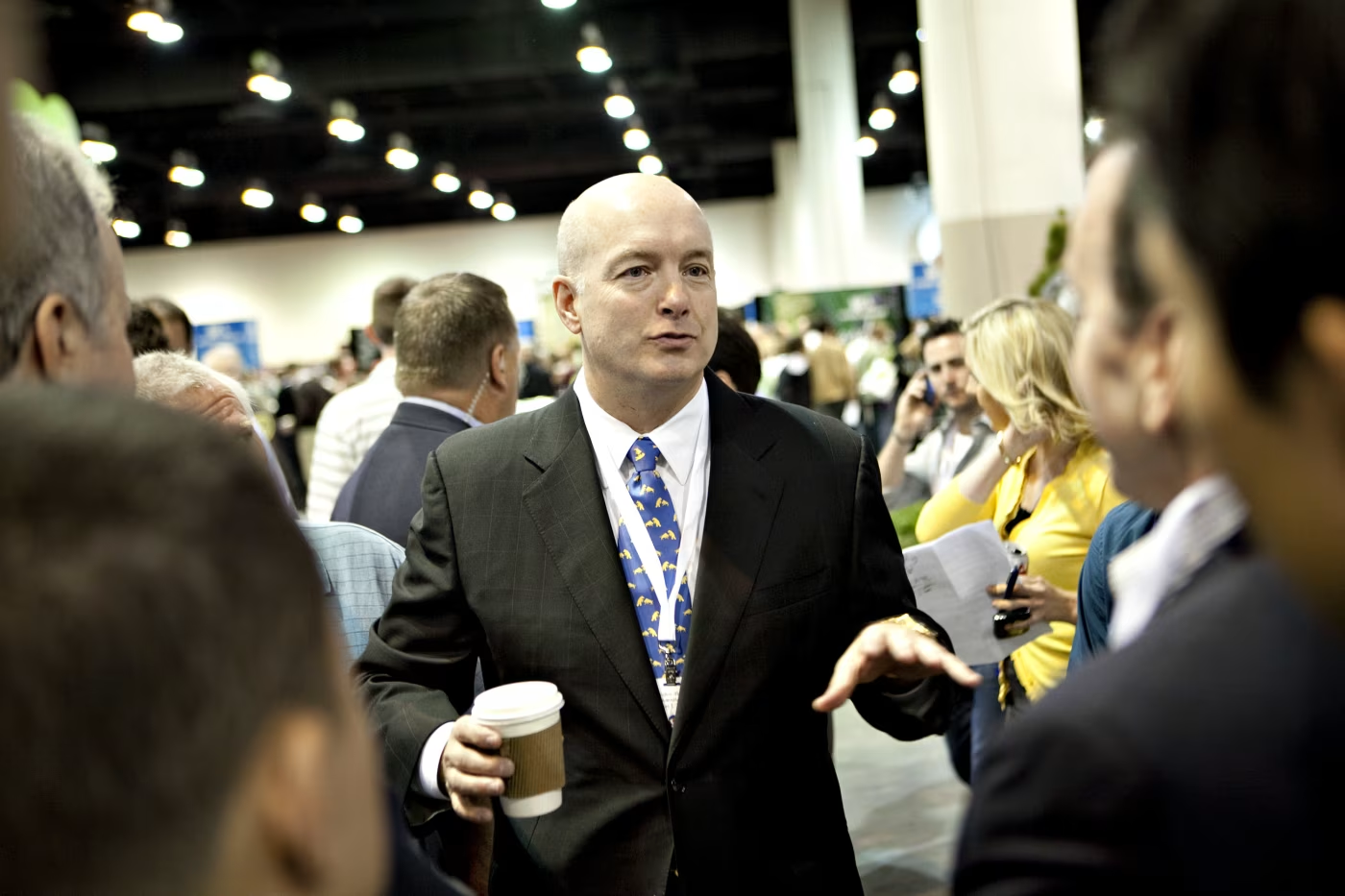
David Sokol at the Berkshire Hathaway annual meeting in 2010. Daniel Acker/Bloomberg News
The Berkshire Succession Story: The Man Who Almost Replaced Warren Buffett — and the CEO Who Actually Did
For years, Berkshire Hathaway’s succession plan looked like a two-track system: keep the culture stable, keep capital allocation disciplined, and make sure the “next Warren Buffett” narrative never becomes bigger than the business. In that framework, one name once sat unusually close to the top: David Sokol—the executive many insiders and shareholders quietly believed could one day take the wheel.
Today, Berkshire’s succession is no longer theoretical. Greg Abel took over as CEO on January 1, 2026, while Buffett remains chairman—an intentional governance design to preserve continuity while shifting day-to-day leadership.
This is the deeper story behind that transition: how Sokol became “the almost-successor,” why he fell, and what Abel’s rise signals about Berkshire’s operating system in the post-Buffett era.
1) Why David Sokol was viewed as the heir
Inside Berkshire, “successor” has never meant a single superhero role. It’s more like a relay team: operations, insurance risk, investing, and culture all need to stay aligned. Sokol looked, for a time, like someone who could unify those lanes.
According to The Wall Street Journal, Sokol built a reputation as a results-first operator who won Buffett’s trust by improving major subsidiaries—most notably MidAmerican Energy (later Berkshire Hathaway Energy) and NetJets—and by demonstrating the rare combination Berkshire prizes: strong execution and capital discipline.
He also played a pivotal behind-the-scenes role in elevating Greg Abel early—Abel’s rise at MidAmerican/BHE is often described as happening in Sokol’s orbit, with Sokol advocating for him to Buffett years before Abel became the public succession choice.
In other words: Sokol wasn’t just a candidate; he was part of the “bench-building” architecture.
2) The Lubrizol trade that ended the story
Then came the moment that still reads like a governance case study.
In 2011, Sokol resigned after it became public that he had bought shares in Lubrizol shortly before recommending Berkshire acquire the company, generating a profit reported around $3 million. Berkshire’s audit committee judged the behavior unethical, even though there was no legal action taken against him.
Buffett later characterized the episode as a serious lapse and publicly criticized the trade, and the resignation landed with force because it wasn’t about operational performance—it was about trust and process, the two non-negotiables in the Berkshire culture.
The takeaway is blunt but important: at Berkshire, the “succession scorecard” is not primarily financial. It’s ethical judgment under pressure.
3) Where Sokol went after Berkshire
After leaving, Sokol largely stepped out of the spotlight, investing privately through his firm and later resurfacing periodically in financial media as an investor. The WSJ notes he remained supportive of Berkshire’s direction and expressed support for Abel’s leadership, even as shareholders continued to debate how quickly his prospects unraveled.
That matters because it underlines a subtle point: Berkshire didn’t “replace a person.” It protected a system—and a public reputation built over decades.
4) Why Greg Abel is the “Berkshire answer” to succession risk
If Buffett is the ultimate capital allocator-storyteller, Abel is the ultimate Berkshire operator: steady, process-driven, and culturally aligned.
Reuters describes Abel’s rise as being grounded in Berkshire’s long-term ethos—spend wisely, decentralize, avoid ego, and keep compounding boringly effective. Buffett confirmed Abel’s elevation at the 2025 shareholders meeting, setting up a clean handover at the start of 2026.
And Berkshire backed that transition with a very visible signal: Abel’s 2026 pay was raised to $25 million, a sharp contrast to Buffett’s famously modest $100,000 CEO salary—while still reflecting Berkshire’s tendency to pay for responsibility and outcomes rather than Wall Street theater.
This is the new operating model:
- Buffett stays as chairman to anchor culture and long-horizon thinking.
- Abel runs the machine, especially non-insurance operations, execution cadence, and leadership talent.
- Insurance leadership remains crucial (Ajit Jain’s domain), because float + underwriting discipline remains the Berkshire engine.
5) What investors should watch in 2026
Berkshire’s “post-Buffett risk” is often exaggerated because the company is structured to survive any single individual. The real questions are more operational than mythical:
A) Capital allocation without Buffett’s aura
Even if the playbook stays the same, markets will test whether Berkshire can deploy cash at scale with the same restraint and timing once Buffett is no longer CEO. The governance structure (Buffett as chair, Abel as CEO) is designed to smooth that credibility transition.
B) Culture preservation across 60+ subsidiaries
Berkshire’s decentralization works only if leaders internalize the “no bureaucracy, high trust” model. Abel’s reputation is that he understands this cultural plumbing deeply because he grew inside it.
C) Incentives and transparency
Abel’s compensation change is a signal of accountability: Berkshire is paying for operational leadership at scale—while remaining distinct from typical corporate pay theatrics.
D) The bench behind Abel
The Sokol episode is a reminder: Berkshire succession isn’t only about the top job; it’s about a pipeline of leaders who can be trusted with autonomy and capital.
6) The strategic lesson: Berkshire doesn’t choose a “hero.” It chooses a “system”
The irony is that David Sokol arguably fit the “hero successor” storyline better than most: decisive, battle-tested, visibly effective. But Berkshire is not a story stock. It’s a governance machine that compounds credibility, and credibility collapses quickly when process and ethics wobble.
That’s why this succession arc is so instructive: Berkshire didn’t lose a successor. It reaffirmed its standard.
And that’s also why Greg Abel is the logical endpoint. Not because he is Buffett 2.0—but because he is Berkshire 2.0: a continuation of the operating philosophy, without the personality dependency.

News
Opinion
WIN Membership
Customer Service
More